
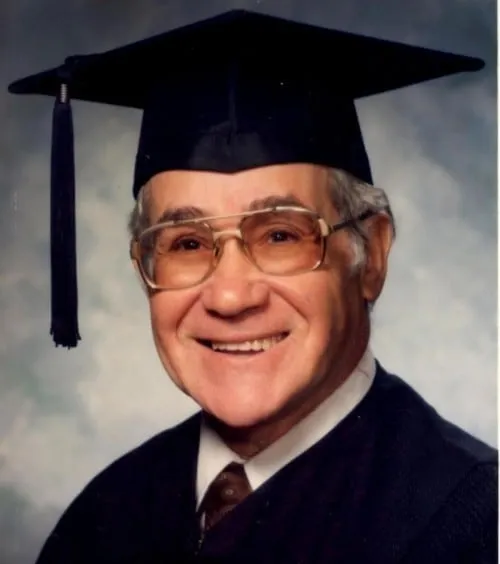
See the photo? That’s my dad, Abraham “Al” Letich, the day he graduated college at the age of 60. It was one of the proudest days of his life. He never knew it, but I can tell you with 99 percent certainty that he had ADHD-Predominantly Inattentive type, or more simply, Inattentive ADHD. It’s the kind I inherited from him. And though my paternal grandfather died long before I was born, from what I’ve gathered about him, most likely he had Inattentive ADHD as well.
Most likely I come from a very long line of Jewish men, and probably women, who had ADHD. But nobody knew about ADHD in my grandfather’s day, or my father’s, or even in my own childhood. Back in the 1960s and early ‘70s when I was in school, very few people talked about ADHD, and the few who did spoke of it only in reference to children who were disruptive and hyperactive.
That wasn’t me; I wasn’t hyperactive. But with my fidgetiness, my sloppiness, my daydreaming and constant doodling, and my missed or last-minute homework, many of my teachers would get angry or annoyed at me. I’ll never forget the time my fourth-grade teacher turned my three-leaf looseleaf binder over in front of the entire class. Of course, papers flew in every direction.
They said I wasn’t working up to my potential. Hell, I knew that better than anyone! But I had no idea what to do about it. Being raised only by my ADHD father (my mother had died of cancer when I was three), I wasn’t learning the skills I needed to manage it.
But I was unusually bright, so I could get almost all A’s all the way from grade school through high school, even though I never studied and began most of my research term papers two days before they were due. (This was looong before there was an internet, so that was a feat!)
My ability to coast ended when I got to college. My freshman year was a disaster, and I quit. Eventually I did get my Bachelor’s and Master’s degrees, but I had more than my share of stops and starts, aimless wanderings, and angry teachers and bosses frustrated with my missed deadlines, lack of sensitivity to their needs and requirements, and my touchiness.
I was brilliant, but only intermittently. I had loads of talent and ability, but I couldn’t harness it. I didn’t want to live a “mediocre” life, but I couldn’t get myself in gear enough to become all that I could be.
During this time — in fact, beginning when I was 13 — I went several different times to therapy to find the “causes” of my problems. Given my childhood, it wasn’t hard to find causes. But while I gained much insight and self-awareness, and resolved a number of true psychological issues, most of the problems that most got in my way didn’t really change.
It wasn’t until 1994 when I read Driven to Distraction that I realized I had ADHD, and I began taking medication for it. Thank God for that. I was thirty-nine, and my Inattentive ADHD was getting worse.
Medication helped me tremendously. But it wasn’t enough. I was concentrating better, and I was even able to accomplish many goals, but I was still just barely coping. I would go on stimulant medication for a while, then go off them because I would think they weren’t helping me much, then get overwhelmed and go back on them. This went on six or seven years.
Though I could concentrate and stay focused better, many of my ADHD behaviors hadn’t changed that much. Even as I was helping other people with their problems, my life was a constant struggle. I didn’t know it could be different.
That’s when I realized I had to learn everything I could about ADHD. Most importantly, I began to study it in myself, breaking it down, understanding how it works. Then I began to apply what I learned to my clients.
I was excited by what I was accomplishing. But in 2010 I read an article in ADDitude Magazine that took my work to another level. It was “Devastated by Disapproval,” the original article written by Dr. William Dodson on Rejection Sensitive Dysphoria, or RSD.
“D by D” transformed the way I worked with clients. From then on I knew that I had a special calling to help people with the emotional side of ADHD.
I will never stop having Inattentive ADHD. Planning, for example, will never be my forte. But I know that with time, effort and intention, it’s completely possible to become more reliable, responsive and consistent, more capable of meeting deadlines and remembering important details. It’s also completely possible to become less emotionally reactive. If there’s something you really desire in life and are willing to learn how to go about getting it, you can do it, despite your ADHD.
I like to say that people with ADHD are just like everyone else – only more so. Everybody needs love and support, and we who have ADHD simply need more of it. When people with ADHD are not beaten down by all the failures and mishaps that befall them because of their glitchy brains, they are some of the most interesting, open, enthusiastic and lively people you will ever meet.
Helen Keller once said, “Life is either a daring adventure or nothing at all.” That is absolutely true for people with ADHD. ADHD may make you rather immature at twenty, but if you treat it and deal with it and take care of yourself, later in your life it keeps you young in mind and heart.
Ten or fifteen years ago I wouldn’t have said this, but today I can: I feel gifted for having had ADHD.
0 Comments